Wednesday, June 9, 2010

Exploring Career options Overseas

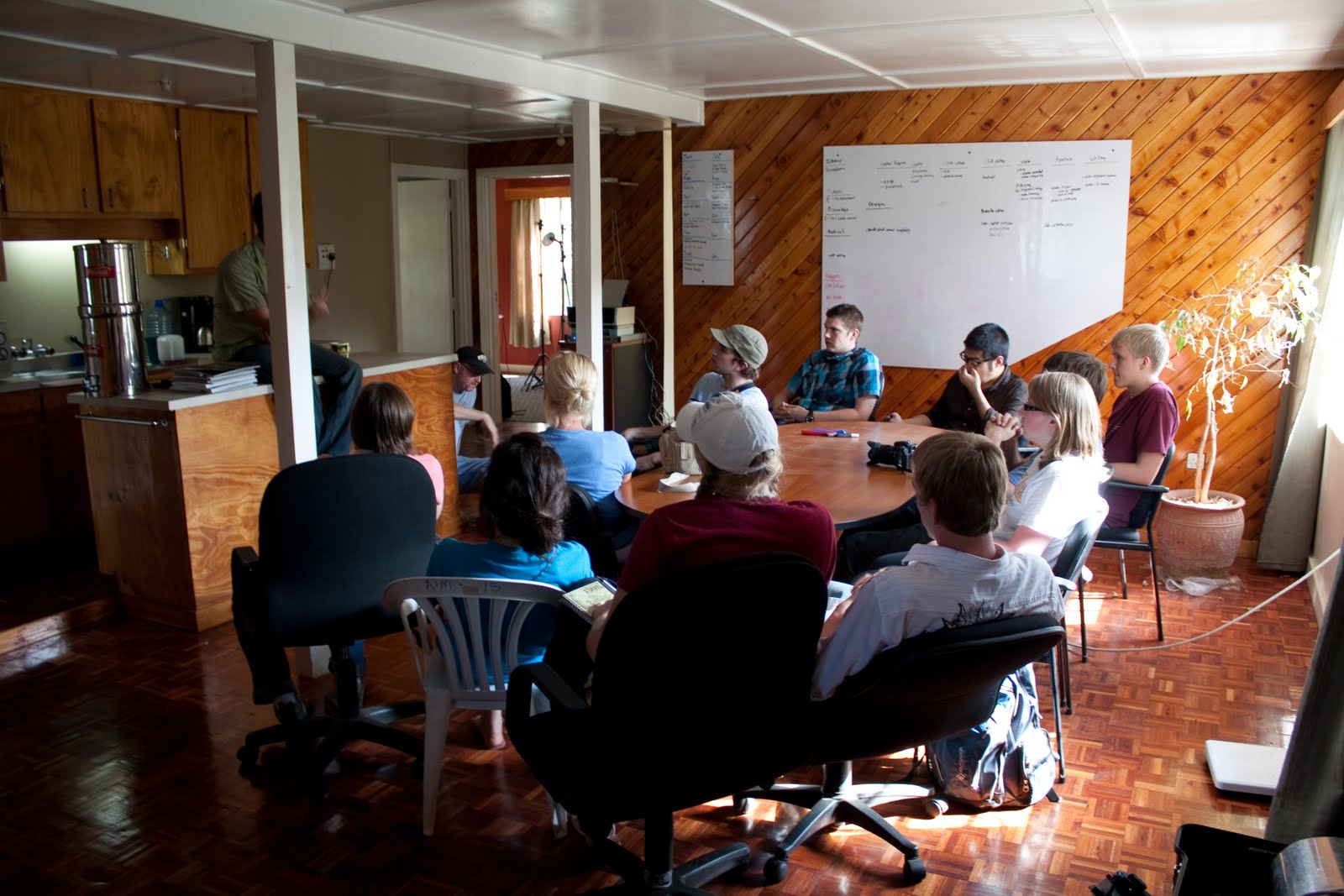
While our film crew (12 students and me) were in Nairobi, we took a few hours out of our day to meet with Andy Brown of OFM—On-Field Media.

OFM is ministry of Africa Inland Mission, an organization with hundreds of missionaries scattered across Africa, doing evangelism, leadership training, Muslim outreach and so much more.

OFM exists to help tell stories of what God is doing through AIM missionaries across Africa. A lot of missionaries—gifted as they are—struggle when it comes time to go home and raise support, to tell their stories, to generate interest, prayers and giving. OFM does a superb job of helping them make professional videos, print pieces, webisodes and more. Our team spent a few hours with Andy, learning the history of OFM (it’s not a very long history), learning what they do and how they do it, and what the opportunities are (there’s a lot of opportunities!).

One of the exciting ideas that came out of our time together is a way to be mutually beneficial to each other. OFM needs interns. Dordt’s Digital Media major needs great places to send interns. The more we talked, the more excited we all got about summer interns from Dordt living and working in Nairobi, and even pursuing a semester abroad—working with OFM.

We’ll see where it all goes, but in the meantime, the thirteen of us had our horizons expanded and students have yet another career option to consider.

Monday, January 11, 2010

Welcome to Mathare Valley, Kenya


CURIOUS ABOUT THE PHOTOGRAPHER IN MATHARE VALLEY.


A GOOD LOOK AT THE CONSTRUCTION MATERIAL USED IN MATHARE VALLEY


AN OLDER GENTLEMAN SELLING GOODS DOOR-TO-DOOR IN THE VALLEY, TRYING TO MAKE A LIVING.


A CITY WITHIN A CITY. SHOPPING, DOING BUSINESS DOWN IN THE VALLEY, ON THE OUTSKIRTS OF NAIROBI, KENYA


A TYPICAL DAY ON A BUSY "AVENUE" IN MATHARE VALLEY.


ONE OF THE MANY, MANY SIDE "STREETS" IN MATHARE VALLEY.


A YOUNG MAN STANDING ON A ROOF TOP, OVERLOOKING PART OF MATHARE VALLEY.


LAUNDRY DAY NEXT TO THE MATHARE RIVER IN MATHARE VALLEY.


MATATUS, PUBLIC TRANSPORT VANS IN NAIROBI, WENT ON STRIKE, FORCING TENS OF THOUSANDS OF SLUM DWELLERS TO WALK TO WORK IN THE RAIN.

Tuesday, January 5, 2010

Selling Maize on the Slopes of Mathare


We’re on a quest to figure out the economics of slum life this week, so if you hate numbers, I apologize.
We spent time with Felix today. He’s 16 and lives with his sister Winnie, who I wrote about a few days ago. She’s the one who fetches water and pays an exorbitant fee.
Felix does his own bit to help the family survive down in Mathare Valley and this is how it goes.
We followed Felix out of the slum at 5:30 a.m. to the Gikombo Market to buy maize. It was raining so the normally fetid slum was abnormally fetid. It was downright gross. We slithered down to the Mathare River, crossed the bridge and scrambled up the other side to reach the main road so Felix could catch a Matatu (public transport) to go the 5km to market.
The Matatu Operators Association had threatened a general strike for three days, starting today, and they were true their word.
Nairobi is a city of over 3 million people. Locals tell me that maybe 5% of those have private vehicles. The rest use public transportation. The strike—called because of alleged police corruption (matatu drivers are tired of paying bribes, they say)—has a direct and immediate impact on the poor.
Take Felix for example. It’s raining. It’s very muddy. And this 16-year-old kid needs to make some money today so he and his siblings can eat. The strike means he now has to walk 5km to market, do his business there, then lug a heavy sack of maize the 5km back to the slum.
We filmed Felix and tens of thousands of others as they walked into town. It was like a river of humanity as people scrambled to get into work so they wouldn’t lose their jobs. We took Felix the rest of the way and watched as he went down a dirty side street to purchase a sack of maize for resell. When he was done, he waded out of the mud and began the hike back to Mathare Valley. We took him most of the way and were once again amazed at the flow of humanity out of Mathare, into Nairobi proper.
Felix took his maize back to his shack and boiled the corn in the husks for several hours. When it was ready, he hawked the maize in the slum for awhile before settling down on a corner somewhere to let people come to him to purchase maize. It took him almost the entire day and when it was all done—assuming he sold it all—he would make a profit of 105/=, or, $1.40.
Here are the numbers:

40/= Matatu Fare to buy the maize
50/= Charcoal to boil the maize
05/= Water to boil the maize
400/= Purchase of the maize

Felix purchases three ears of corn for 20/= and then sells the boiled ears for 10/= each. If he sells his 400/= of maize, he makes a total of 600/=. Remove expenses and Felix is left with 105/= ($1.40). Today he did well because he did not have to pay Matatu fare as we took him with us. In the afternoon, when it was really hot and we all needed a break, we stopped for sodas. I paid the 30/= for each soda (about .50 cents) and later, when I was doing the numbers, realized that the soda I bought for Felix would have been almost a third of his daily profit.
This is not a lazy kid. Felix works hard to make it, but no matter how hard he works, the economics just don’t add up. He says he wants to be an engineer and see “London and America.” Selling maize on the slopes of Mathare Valley is not the path that will take him there.

Sunday, January 3, 2010

Meet Emily

Emily is a young Luo woman we met in Mathare Valley. She’s 27, has two children named Ian and Olga, and a husband. They live near the edge of the slum in a shack made of iron sheets that measures 9 ft x 12 ft. She’s lived in Mathare most of her life.
We did some math today and this is what we found.

Emily cleans for a Somali family in Eastleigh and earns 1,500/= per month (approx $20). Her husband is a watchman and earns double that for a total monthly income of 4,500/= ($60) per month.
Here are the monthly expenses:
1,300/= Rent
800/= Water
300/= Use of public toilet
1400/= Public transport for husband to get to work each day (price immediately goes higher if it rains).
300/= Public transport for Emily to go to work assuming 10x per month. She walks the rest of the time (one hour each way) to save money.
480/= Daycare for 3-yr-old Olga. Emily also has to send a lunch with Olga 6 days per week.
300/= Ian’s school fees (Ian is 8).
700/= Cooking Fuel (combination of charcoal and firewood).
5,580/= Total which is 1,000/= more than what they earn. This does not include food, the cost of a yearly school uniform for Ian, medicine, entertainment or anything else.
Either the income is off, or the expenses are off, or Emily and family are struggling mighty hard to stay afloat. My hunch is it’s a combination of all three of those.
As we tromped around in Mathare today doing interviews and getting to know people, it became apparent rather quickly that Emily is not the exception. She’s the norm.

Saturday, January 2, 2010

The Cost of a Drink


Today we entered Mathare Valley. Piper, one of the crew members, asked, “What’s the nastiest slum you’ve ever been in?”
After some thought I had to say, “Mathare Valley.”
I first entered Mathare Valley in 1985 as a college student. It was my first exposure to severe poverty and I’ve never forgotten the experience. Within a year, my parents joined me in the Valley.
Fast forward to 2010 (We spent New Year’s Day 2010 in Mathare) and it doesn’t look like much has changed.
Mathare Valley is a teeming mass of humanity separated by thin walls of mud or cardboard or iron sheets or even burlap. A complete lack of zoning means narrow, winding corridors become the main avenues and a lack of sewage services mean incredible filth spilling down the corridors into the Mathare River at the bottom of the valley.
In this place, clean water is gold.
Felix is 16. His older sister Winnie is 18. They and the rest of their family live in a tiny hut-indistinguishable from the others, in Mathare. They were born in this slum.
They pay 5/= (that’s how you write “five shillings”) for 50 litres of water. They go through at least 250 liters a day for a total cost of 50/= (about US 75 cents).
Winnie’s parents make between 2,500/= and 3,000/= per month. If we go with the higher amount of 3,000/=, they earn approximately 100/= a day (about $1.25).
This means half of the household income goes toward one thing: water.
Let me say that again. Half of their monthly household income goes to water.
And its’ not even good water. It’s Nairobi tap water, which our crew was warned repeatedly not to drink while we’re in Nairobi working. And they have to go fetch the water.
How many of us reading this spend half our income on drinking water?
I don’t have access to my latest utility bill, but I pay a fraction of my monthly income for very clean drinking water that comes out the tap in several different parts of my house.
Something ain’t right here.

Thursday, December 31, 2009

Mitumba

Pastor Shadrack and his wife, Violet, are Luos (that's one of the largest tribes in Kenya) and work in a slum called Mitumba.
Mitumba is a tiny little slum, a mere 15,000 people jumbled together in a tiny corner of the city. Airplanes from Wilson airport zoom overhead and across the fence is the edge of the Nairobi Game Park.
Mitumba is a Swahili word for "cast off," or "second-hand," or "worthless." It's the name Kenyans give to the huge loads of cast-off clothing that makes its way here from North America. It's Mitumba, cast-off, no one else wants it. Mitumba is where these people live.
It's also a state of mind. Pastor Shadrack knows full well that these people consider themselves "Mitumba." Of no worth. Cast off.
Shadrack and his wife, Violet, have been at work here since 2002 and their number one goal is to move this mindset from "worthless" to "of great worth."
They're doing an excellent job.
They and a crew of volunteers and staff educate over 400 children grades one through eight, and feed them too. They shelter over 20 orphans; kids who have lost both parents. They preach the Gospel and a lot of other things too.
To an outsider, the ramshakle buildings where this all takes place, tucked in Mitumba Slum, are nothing special. In fact, they don't look so much different from the other shacks and buildings going on. But the fact is, these buildings--and what happens inside them--is absolutely transformative.
Over the years, not only has education increased, but so has hygiene, and trust. Two years ago, when slum communitities around Kenya were erupting with violence because of the presidential elections, only Mitumba Slum was spared the violence. Shadrack and Violet were later recognized by the government for this rather impressive feat.
But more importantly, the people of Mitumba are beginning to realize that this name--Mitumba--does not have to be a self-fulfilling prophecy. It's just a name, and they do have worth. They're starting to know that now.
So for the next week, Daniel, Luke, Hani and Danielle will have the awesome privilege of trying to tell this story in a compelling way. It's one of the pro bono projects we're doing to do our bit to help those who are helping the poor.

Oh, Andrew showed up this morning so we're all here. Excellent.

Feels Like Home

We made it. After several false starts (strong winds in Newark mean a 3-hour layover in Omaha...nope, get on the plane it's leaving on schedule ... strong winds mean the flight to Paris is canceled...cancel the cancellation, the flight is leaving on time) we arrived in Nairobi an hour early. All went mostly well. We're missing Andrew. His flight out of Houston was delayed so he's on his own. We expect him in the morning. We're also hoping our luggage arrives in the morning.
It feels great to be back in Kenya, where I lived for 7 years. And it's great to share the experience with a dozen other people. In the days ahead, we're looking forward to meeting some great people, telling stories and using cameras and mics to help others understand the stories we want to tell.
Talk to you soon.

Saturday, December 12, 2009

Into Africa

On December 29, 13 of us will travel to Nairobi, Kenya for our third, and final shoot in slums for the slum documentary film we're working on.

We have already tracked individuals living in slums in Asia and Latin America. The final piece of the puzzle lies in Africa.

I used to live in Kenya, so have a lot of contacts there. We'll be working closely with Pastor Shadrack Ogembo, Pastor Daniel Ogutu, and a new friend, Father Ted Hochstatter.

Ogutu and Ogembo have been friends of mine since 1985 when I first went to live in Kenya after my Jr. year in college. We'll be doing pro-bono work for all three of these men, like we did in Manila. Plus we'll be shooting stories for the slum documentary.


Pastor Daniel is my main contact for finding just the right family for the documentary. He has already sent me some pictures--the ones you see in this blog--of people he feels will help us capture the story of the one billion people living in slums.


So far, they are just faces in a picture. No personalities, no names, no family histories. The beauty of this project is taking anonymous folks like this, taking jpgs, and having the privilege of discovering who they really are. And helping our viewers discover that too.


For the last few months, our team of 13 has been through quite a bit together. We've done fund raisers, students have written letters asking for support, and we've planned things out. Now the funds are in and sufficient to make this trip happen. We're excited to create publicity materials for three different groups working among the poor in Nairobi, as well as get the material we need to create this documentary.


Please keep an eye on this space over the next few weeks as I'll be putting stories here of what we discover, who we discover, and what we learn about what I'm starting to refer to as "The Fourth World," the world of slums.

Sunday, June 21, 2009

LONG-Term Disaster

CRWRC works under the name of GenAssist here in Banda Aceh in Indonesia. They came almost immediately after the Tsunami of December 26, 2004. They’re just wrapping up now.

The other night, GenAssist threw a huge party at one of the universities here in Aceh. 500 or so people showed up, the governor of the region, the mayor, other important government officials, some impressive dance troupes, musicians, food and drink were served, and for 3.5 hours, these people remembered what happened, and celebrated all the good work done by Muslims and Christians—working together—for the past 4.5 years.


When disasters hit an area, they tend to hit the news headlines pretty hard too. We probably all remember the Tsunmai, the massive earthquake in China, the chemical explosion in India some years ago, Chernobyl. But once the headlines fade away, so do our thoughts of the event.


This celebration was a powerful reminder that tragedies linger. For years. For the people of Aceh, the Tsunami will not be a distant memory for the next few generations. You can’t drive very far through this city without seeing a monument, a plaque, an escape building, a mass grave, and be reminded that this Tsunami was for the people of Aceh what Hiroshima/Nagasaki was for the Japanese a few generations ago. It forever changed them.


Seeing that celebration also made me realize that organizations that go in, claim the limelight while it’s there, then leave, would be better off never showing up in the first place. It’s quite possible that they do more harm than good.


CRWRC goes in for the long haul. They stick it out until the job is done, or at least until the infrastructure and talent is in place to keep things moving toward restoration.


Here in Aceh, they’ve built houses, trained thousands of people to have new livelihoods, worked with government leaders, and are leaving a very qualified and gifted group of people behind to tie up any loose ends in the months and years to come.


So even though the headlines left years ago, and our memories faded fast on the devastation of this Tsunami, my little blog is one attempt to bring to light the fact that this tragedy isn’t over yet. For the people of Aceh, it’s a daily reality. For CRWRC, it’s now a job well done.


As a footnote, CRWRC has just applied for a large grant to help them get started in Southern Sudan where a tsunami of war, violence, starvation and, dare we say it? Genocide? is under way. It will be interesting to see how long they stay there after the headlines fade away.


I suspect they’ll be there awhile.

Friday, June 19, 2009

The Photograph

We interviewed several people today and asked them to tell their story of what happened on Decemember 26, 2004, the day of the great Tsunami.

Ihya’s story goes like this:


He lived near the ocean and heard of what was coming. He grabbed their young son in one arm, and his wife was hanging onto the other arm. They ran—literally ran—for their lives away from the ocean.


As they ran, he looked back and “saw a mountain of water behind us.” They kept running, looked back again and saw the mountain coming closer.


His son was ripped from his arms, then his wife. He went unconscious and when he came too, saw he was near a roof a building. He grabbed hold but then that building collapsed.


Somehow he managed to survive.


Just before the Tsunami hit, Ihya’s parents made the pilgrimage to Mecca. Before they left, they took a picture of their son, his wife, and their son. That picture was in the camera they took with them to Saudi Arabia. It’s one of the only things Ihya has left to remember his family by. He had the photo enlarged and brought it out to show to us.


CRWRC, the organization that has worked here for the past four years, has helped Ihya, and hundreds and hundreds more just like him, aquire housing and meaningful work since the Tsunami. Seeing Ihya in his new home, and hearing him talk of the girl he’s now dating and hopes to marry, makes me realize that hope can emerge from such a dark story.

Thursday, June 18, 2009

Religion

Grand Rapids, Michigan, where I used to live, is known as a city of churches. There’s one on every corner. Banda Aceh, on the tip of Sumatra here in Indonesia, is a city of mosques. I don’t think I’ve ever seen so many mosques in one place. Green domes, gold domes, silver domes, multi-colored domes, black domes. They are beautiful to look at and there’s something haunting about the call to prayer.

Our guide and driver, Yassir, is a Muslim. Today when we finally broke for lunch, we were just sitting down when he asked to be excused for “about 10 minutes.” It was time for prayer. That’s devotion.


Garuda Airlines, one of Indonesia’s airline companies, has an in-flight magazine. The current issue has two full pages, prominently displaced just before the maps in the back of the magazine, giving “Invocations” to all so we can pray before the flight takes off. These invocations are offered in a variety of languages, but I’ll just give you the English, exactly as printed in the Garuda magazine:


Islam:


We seek the help of Allah, the most Gracious, the Most Merciful… Who has bestowed upon us the will and ability to use this aircraft without Whom we are helpless. Verily, to God alone, we worship and to God alone we shall return. Oh Allah, shower us with Your blessings and protect us on this journey from any hardship or danger and protect also out family and our wealth.


Protestant:


Lord in heaven, we praise and thanks of thy bless and endless love in our live. In this opportunity, we call They holly nname to accompany our journey. We believe Thou will guard and protect our plane from any disturbance and danger. To the all air crew, Thou will lead their duty in order for us to arrive in destination in time and save. Thank you for Thy help and firm love from beginning, now, and forever, In the name of Yesu Christ, we pray, Amen.


Catholic:


In the name of the Father, the Son and the Holy Spirit, Amen. Long Ago You save the children of Israel who crossed the sea with dry feet. And three wise kings from the East received Your command with the guidance of a star. We beg You. Bless us with a safe trip, with good weather. Bless us with the guidance from your angels, so that the crew of this aircraft will lead us to our destination safely. We also hope that our family remain happy and peaceful until we land safely. Blessed be Your name, now and forever. Amen. In the name of the Father, the Son and the Holy Spirit, Amen.


Hinduism:


Om Sanghyang Widhi Wasa the Greatest, all wealth and intelligence comes from your blessings. Keep our minds and manners pure and let us attain inner peace and happiness.


Buddhism:


Praise be to Sang Bhagavca, the Pure. One who has attained enlightment (3x)


Let All Creature live in happiness in accordeance to Your will. (Paritta Suci).


Confucian


In The Name of TIAN, The God Almighty. In The Highest Place. Under the guidance of our Prophet Kong Zi. Be Honor. SHANG DI, The Supreme God. Please be your guidance for all the airline crews. So they can perform their job accordingly. Please bless us all. So that we can arrive at our destination savely. And so to unite with our beloved family.


Thursday, June 4, 2009

Rebuilding Banda Aceh

On December 26, 2006, a tsunami raced through the Bay of Bengal and killed over 260,000 people. Many of those victims were on the northern tip of the Island of Sumatra in Indonesia.


Since then, CRWRC (Christian Reformed World Relief Committee) has spent millions of dollars to put lives and communities back together. That’s not so unusual. CRWRC does that. What’s rather unique about this story is that Banda Aceh (pronounced A-chay), the community at the tip of Sumatra—the one that got hit hardest by the tsunami—is a Muslim community.


Next week I’m going to Banda Aceh to help CRWRC tell the story of what they’ve been doing since the tsunami hit.


It’s not part of the slum documentary, but yet it is. It’s a story about people who are “down on their luck,” people who needed a hand—and got one. Slum dwellers often don’t get that helping hand. Because their needs are chronic and never ending, we tend not to notice. But when a tsunami hits and takes out a couple hundred thousand people, we notice.


I’ll write about my experiences on these pages and tell some of the stories of the people I meet. I hope you’ll forgive me for using the Slum Doc blog to tell a different kind of story here.


On another note: I love fine coffee. My favorite is Sumatra from Starbucks. I’ll see what I can find on Sumatra J

Friday, May 22, 2009

Impunity

A woman was murdered here last night.

In Guatemala, that’s not so unusual. Last year, 620 women were murdered, and not one person was brought to justice over it.


While filming in Guatemala, we are staying at a seminary, the largest in Latin America. It’s a beautiful oasis in a violent city. High walls surround lovely green areas, well-manicured lawns, well-kept buildings and engaging students.


We left the compound at 8 a.m. for our day of shooting. At 7:30 a.m., the woman who cleans the rooms, makes sure the towels are fresh and who keeps the guest comfortable, was dropped off right in front of the main gate of the seminary.


A student who lives across the street was an eye witness to what happened next.

The cleaning woman (who’s name I do not know) alighted from the vehicle and moved toward the gate.


A car sped around the corner and a well-trained assassin leaned out the window with his pistol and shot the woman in the head.


The car sped off and the woman collapsed in the arms of her sister. She died soon after.

The eye witness said it was a well-executed operation by a well-trained person. Apparently it’s quite easy to hire such a person in Guatemala.


One of the seminary professors knew the woman quite well and she’s the one who told us about the 620 murders of the previous year. Trembling with anger and frustration, the professor told us that most likely, some routine paper work would be done on this murder and then it would be put in a file somewhere and would most likely never see the light of day again.

The professor talked of those who operate with “impunity.”

Seeing her anger and helpless frustration gave me an inkling of what the residents of La Limonada slum must feel at times. The Ministry of Justice building is an imposing structure (see photo) that stands literally on top of the ridge overlooking La Limonada. The task of the Ministry of Justice would be similar to the FBI in the USA. They are charged with investigating murders, suspicious deaths, etc. Being so close to La Limonada, a violent slum in a violent city, should be job security for them.

However, as we found out, what happens in La Limonada stays in La Limonada. According to those who live and work down in that deep ravine, murders that happen there are just not worth investigating by the Ministry of Justice.

At certain times of the day, the shadow of the Ministry building literally falls into the slum. But that’s about all the residents of the slum will get. Murders down there are not investigated.

Imagine being one of those residents and knowing that murderers can operate with impunity. Simply being a resident of La Limonada makes you unworthy of official protection. You’re on your own.

The United Nations says some characteristics of slums include lack of security of tenure, lack of security and lack of sanitation. For those in La Limonada, we could also add lack of rights.

Selma's War

I have never, ever, in my life, heard a story quite like Selma’s.

Imagine Job. You know, the guy in the Old Testament book of Job. Now add rape, sexual abuse, physical abuse and a severe beating with a machete, add a life-time of rejection by an alcoholic mother, being sold by her to the sex trade, a string of men who added to the rejection and abuse she felt, and you start to get an idea of what Selma’s story is all about.

Being a journalist, or in my case, a documentary film maker, opens up portals into stories and lives one could never enter otherwise. I remember interviewing a lovely woman in Sierra Leone who was finally, a few years after the war there, recovering her sanity. She was buried in a deep hole for days, was raped, assaulted, tortured, and made to hold the severed head of her aunt for hours on end. That happened during a war so in some bizarre, strange way, maybe the fact of war somehow lessens the horror of her experience for those that hear her story later.


But Selma’s story takes place in Guatemala. Today. The war officially ended in 1996 but even so, her story really had nothing to do with the “official” Guatemalan war.


When Selma finished telling her story to Tita and, in effect, to you the reader of this blog and eventual watcher of the film, Tita and Selma hugged each other tightly and they both wept for several minutes. It was a most holy moment there in Selma’s house. Iron sheets on a narrow spit of land on the side of the steep ravine that is La Limonada.

After catching my breath, Tita told me that Selma’s story is actually not that unusual. Women in Guatemala are abused and beaten all the time. “At least 50% of them,” she said.


I suppose poverty is a war of sorts. It assaults its victims and puts them in situations and predicaments that would seem unimaginable in peacetime. Selma, the men that beat her, the impoverished alcoholic mother, the men that used Selma when she was sold as a nine-year-old girl; all part of the violence of poverty.


Does it really have to be this way? In a world that generates so much wealth, does Tanya have to beg on that corner every day, and does Selma have to suffer so much?


Today, as I write this blog entry, Selma is experiencing yet another chapter in her life. She’s having surgery somewhere in Guatemala City to try and remove her cancer.


For her, the war goes on.

Wednesday, May 20, 2009

Begging from a Wheelchair

Today we filmed Tanya at work.

Tanya, you may remember, is paralyzed from the waist down. She was shot 10 years ago and is in a wheelchair. We joined her at 6 a.m. down in La Limonada slum in Guatemala City. Her papa already had her in the wheelchair. She was just putting the finishing touches on washing her face and getting her hair out of her eyes. She has a beautiful face and bright eyes that manage to laugh despite the physical and emotional pain.

Jesse and I followed with our Panasonic HVX hi-def cameras and we had Aaron with us, a friend we met last night. We gave Aaron the Nikon and let him go to work getting photographs for the website and future print pieces. Papa wheeled Tanya through the very narrow corridor on which they live. That empties out onto a wider alleyway. He took that down to the river and then followed the main road out of La Limonada. The main road goes up. It’s the only way to go. Papa doesn’t work as a painter anymore because he has such a sore hip. Picture him pushing Tanya in her wheelchair up a very, very steep hill. (Papa was so exhausted at one point that the film crew jumped in and pushed Tanya the rest of the way up the hill.)


Once at the top, traffic is the main enemy. Cars and trucks and buses fly by. Diesel fumes and smoke hang thick in the air. Papa and Tanya quickly and deftly maneuver through it. They do this every day and are quite good at it. The streets are level for several blocks, then go up again. The traffic increases. It’s 7:30 a.m. Finally, after a two-mile hike that takes them from the bottom of La Limonada slum to a busy intersection in Guatemala City; from a world of gritty survival where there’s no margin for error, to a world of expensive cars, flowers for sale, and coffee shops, Tanya is ready to work.

Papa collapsed on a step and caught his breath while Tanya adjusted her clothing, got the cup out for collecting money and put her game face on. (The cup, she explained, is necessary because so many people who might be tempted to give money don’t want to touch her. She cried when she told us that yesterday in the interview. She said, “they don’t want to touch me,” and she cried.)

So the work day began. She joked around and laughed with the flower vendor on the corner. They must see each other each day there on the corner. And she wheeled herself up and down that incredibly busy intersection in her low, blue chair, reaching up to the windows of SUVs and cars and pickups, hoping for a good day of generosity.


We shot this scene from a variety of angles. Sometimes when you see life unfold through a lens, rather than just watching it with the naked eye as you pass by, you see things differently. What I saw was how incredibly vulnerable Tanya is. That tiny chair, with Tanya in it, next to rumbling buses, diesel trucks, expensive cars and beat-up junkers. Some reach their hands out and place some coins—or paper bills—in the cup. Others ignore her. Others literally don’t see her. This is her life. She does this each and every day because she has to to survive.


By seeing the behind-the-scenes story of this one beggar on a street corner, I and my team have had our perspective changed of beggars in general. It the future, It will be mighty hard to see someone working a street corner in the Developing World and not immediately think of Tanya. We’ll wonder what the story is, who the Papa is, how much do they need to survive, what kind of room do they sleep in.


Getting to know one person has made me aware of a whole class of people.

That’s what this documentary is about. Maybe if viewers get to know a few slum dwellers, like Tanya, Selma (more on her later) and the Alquino family under the bridge in Manila, they will become aware of, and concerned for, a whole class of people called slum dwellers.

All one billion of them.

(photos for this posting: thanks to Aaron Kreuger.)

Monday, May 18, 2009

Behind the Black Door.

Today we entered La Limonda, the largest slum in Central America. 60,000 people crowded into a deep ravine one mile in length. At the bottom of the ravine a rushing stream carries the sewage of these 60,000 people to the Rio Las Vacas which empties into the Rio Motagua, which empties into the Atlantic Ocean.

If you wind your way up from the sewage through narrow alleys, you’ll come to another alley, more narrow yet, and one of thousands just like it. Turn right, wend your way through it and pound on a black door. A man will open the door and let you in. We stepped through a tiny courtyard—literally about six feet across—and into Tanya’s bedroom.

She was laying on her bed, covered with a blanket. The first thing we noticed is that the “normal” shape of a person under a blanket was missing. And that’s part of Tanya’s story.

I won’t trouble you with all the details, we’ll cover more of that in the documentary, but here’s the short version. Membership in a gang, brothers murdered, Tanya shot, bullet hits her spinal cord, she loses the use of her legs, later a severe break means she has one of the legs amputated, she now lives in this tiny room with her father in his own room right behind her. She wheels herself to a busy intersection each day and works—rain or shine—begging next to the cars when they stop at the traffic light. She must earn about 50 Quetzales each day ($1=8Qs) to survive so even during rainy season—now—she must be out there begging.


At the end of a long day, she wheels herself back down into La Limonada, through narrow alleys to her own, comes to the black door and papa lets her in, helps her into bed so tomorrow she can do it again.


Tanya welcomed our crew into our home. She was painfully honest about her life, her frequent thoughts of suicide and her oft-repeated questions of “why me?” What troubles her greatly is the comments people make to her, or about her, as she begs at the corner. Rich people, particularly, are harsh, she says. She cried while telling that story.

She was also honest about how she gets through it all. Her faith in Jesus is what sustains her. By her own words, she went from a hard gang member, to a women with a deep faith in God, despite a personal story even the best Hollywood writers would have a hard time matching.

Tita is the woman who linked us up with Tanya … and is largely responsible for helping Tanya, and many, many more like her, find that deep and abiding faith. Tita’s story is a documentary in itself. Maybe another day.

Meanwhile, Tanya is resting behind the Black Door while I write my blog. Tomorrow morning we will be at the red door at 6:00 a.m. so our cameras can follow her as she makes her way out of La Limonada, over the crest, down to the busy stoplight and begin another day of survival.

Flowers in the Slum

There’s a storm brewing in Guatemala. Last week, a lawyer was assassinated. Soon after his death, a video surfaced with him telling his fellow citizens that if they were indeed seeing him on this video, it meant he had been assassinated and he knew exactly who did it.

The news finally reached the Drudge Report today, which means it’s pretty big.


Being here in Guatemala puts it all front and center.


There were demonstrations again in the central plaza today. We were there later and it looked like a hurricane swept through the plaza and left tons of garbage behind. We didn’t get there in time to film the event though because we didn’t come here to capture up-to-the-minute breaking news. We came to get the much older story of poverty.


Today was our first day of shooting in Guatemala. Joel A, our guide, drives us to the right places, tells us when to shut the windows of our car because the neighborhood is bad, translates for us, and gives us good advice and answers to our many questions.


We didn’t actually go into the slums today, that’s our job for the rest of the week. Today was a day to get the lie of the land, get some establishing shots, get some of the stuff we’ll forget about later like government buildings, landmarks, candid people shots, culture, sort of essence-of-Guatemalan-life shots.


We did get to the outskirts of La Limonada though. We went up on a precipice that overlooks the slum. Actually, the slum creeps right up to the edge of that precipice and almost crawls over. We shot long, wide establishing shots to show this piece of the slum when we were quietly and wonderfully interrupted by the type of hospitality poor people are so good at.


We were shooting when Joel started talking with a tiny, elderly Guatemalan woman who’s home almost reached the top of the precipice. She was curious. What were we doing? He explained. She invited us—four strangers from another country, plus Joel—into her house.


We might enjoy getting some shots through her window, she explained. Then she led us through her little house to the back onto a tiny verandah that emptied out onto more little homes straight down, down the slope of the embankment we were on, a perfect picture of how the very poor build their homes on the absolute worst and most dangerous pieces of land.


She had flowers on her verandah and proudly showed them to us. I asked her (through sign language. My Spanish is horrible) if I could take a picture of her with the flowers. She agreed. You can see her picture here.


We got some great footage from that vantage point; shots we would not have gotten without that serendipitous moment provided by that gracious Guatemalan woman.


In her home, I forgot all about the storm brewing in Guatemalan politics. I forgot completely that I was on the cusp of a slum and surrounded by poverty. In her home we were treated as friends. And our political persuasions, incomes and countries of origin didn’t seem to matter.

Thursday, May 14, 2009

From Tulip Lanes to Slums

It’s Tulip Time in my home town. It’s an annual celebration of all things Dutch. There’s Dutch Dancing in the streets, gorgeous tulips planted by the thousands all over town; there’s windmills and a canal, wooden shoes klomping all over the place and tourists by the thousands who bus in to see the street scrubbing, eat Dutch treats (including almond bars), watch the parades, take trolley tours and more.

In two days, four of us will be in La Limonda, Guatemala City, Guatemala. Though I haven’t ever been to this particular slum, I rather doubt we will see scrubbed streets, tulips, or even authentic ethnic costumes.

I suspect we will find many kind people who are generous to four strangers, and who are fabulously rich in community.

As I explained to my daughter Lauren once when we were filming in San Salvador; there are different kinds of riches. What she experienced there in that poor community was the richness of community. People knew each other, knew each other’s business, names, took the time to talk to one another. There wasn’t a lot of material wealth, but my young daughter definitely picked up on this other form of richness.

We were living in another state at that time, and we certainly did not have that richness of community. When we got back, she was hungry for it. She missed it.

Of the four of us, two of us, Jess and myself, have spent considerable time in this region of the world. Jess is a recent college graduate with a degree in digital media production. He grew up in the Dominican Republic and speaks Spanish fluently.

The other two will have their first taste of both Latin American culture and of slums. One is John, a friend of mine from town. He’s eager to see for himself what life in the slums is all about. John has a big heart for the poor and for justice. I’m eager to see his response.

The other traveler is my dad. He’s 70 years old and though he’s followed his kids around to East Africa and Israel, this week in La Limonda will be an eye opener for him. He’ll carry equipment, hold shotgun mics, recharge batteries and generally do whatever needs doing. And like the rest of us, he’ll meet people who are part of the one billion.

And he'll wonder how some of us can live in tulip-lined lanes, while others live in slums.

Tuesday, May 5, 2009

La Limonada, Guatemala: The Precarious Life

Next week we go to Guatemala to shoot.


Why there and not a favela in Rio, or on the outskirts of Mexico City? Why do the Latin America shoot in Guatemala?


As we looked at the various slums in Latin America (unfortunately, there were plenty to choose from) we decided to focus on a slum that hasn't received much attention from the world. Not that most slums have, but some are more famous than others. Rio, for example, has been featured in several movies and the favelas are almost romanticised in some quarters. Funny how media can make a location famous (i.e., just think about the baseball fields here in my home state of Iowa.)


Guatemala is a small country right next to Yucatan, Mexico. We don't hear much about it in the news, it gets very little attention, and yet, 70% of the population lives on less than US$2 per day. In the countryside, 30% live on less than $1 per day. In the city, 8% does.

Guatemala City has about 2.5 million people and estimates show that at least 60% of them are poor. Those with the lowest incomes live in very precarious situations.

Our goal is to spend a week with two women who live these precarious lives; Tanya and Selma.

Tanya and Selma have stories that border on the unbelievable. We hope to make their stories real and believeable with our lenses and microphones. They live in a slum community called La Limonada, which had its beginnings in 1959.

When the government put an end to the agrarian reform program in the '50s, that, plus socio-economic problems accelerated the migratory process from rural to urban. About 600 families invaded the sides of the gullies in front of the Olympic Stadium and thus was born La Limondada, one of the largest slums in Central America today.

We don't know Tanya and Selma's history or complete story yet, but we hope to find out. As the author Chaim Potok said, "in the particular is contained the universal." Through the particular stories of Tanya and Sara, we may gain clear insight into the more universal story of the plights of tens of thousands more who live the precarious life in Guatamala City and in cities around the world.

I'll post more here about Tanya and Selma, the good people who are making this possible in Guatemala City, our experiences as we shoot, and what we learn. Thanks for checking in.

Tuesday, April 28, 2009

...better late than never.

I'm at a “Going Global” two-day workshop in Santa Monica. The reason I'm here is because I've discovered something all independent filmmakers discover at some point in the production schedule: The marketing and distribution of a film is one of the most difficult aspects of the entire production.

Filmmakers get pretty excited about their films. That's good because it takes a lot of passion and energy to make one! They do the preproduction, they do the shooting, they do the postproduction, and then … then they start asking questions like, “Who's going to buy this thing?” “How will I get this out to my audience?”

I was very fortunate to come across Stacey Parks and her company, Film Specific. Stacey has a long history of working with independent filmmakers and getting sales and distribution deals put together for them.

Stacey had a nine-week, weekly conference call that about 50 of us from around the US and Canada were part of and the topic was, “Distribution in Reverse.” The premise being; whatever stage of production you're in right now, you need to be thinking clearly about the the final stage, which is, marketing and distribution.

To that end, our conference calls were useful in getting us to think about questions like international financing deals, global distribution, the film festival circuit, and the mother of all deal breakers: deliverables.

Deliverables are the myriad nit-picky little things that any TV distribution deal worth its salt, or any deal for that matter, will lay out in the fine print. The list of deliverables can stretch to nine pages long and will include things like:

E&O Insurance: Errors and Omissions Insurance. After I've proved that I did everything possible to mitigate possible lawsuits by having all those who appear in the documentary sign releases, making sure my music is legal, having no intentional slander and so forth, I still have to purchase an E&O policy in case something should arise down the road that could get me or the production company into legal hot water.

Music and FX. For global distribution, there may have to be some recutting, say, in Japan, to make the movie more palatable for a Japanese audience. Music, dialogue, sound FX: all these need to be delivered in a specific format so the editors over there can move things around, make changes, etc., to fit their audience.

Title Tracks. If the Slum Documentary gets shown in, say, Germany, all the subtitles, credits, even the Title, will have to be changed into the German language. There's a very specific way that all these titles have to be delivered to a third-party vendor to expedite that process.

There are a LOT more deliverables, but I'll just copy and paste a few from our notes so you get an idea of what goes on behind the scenes of every movie that actually makes it onto TV or the bigscreen or to your Netflix account:

(a) Original Picture Negative: The original first-class completely edited color 35 mm Film Stock Picture negative, fully timed and color corrected.

(b) Original Optical Soundtrack Negative: A first-class completely edited 35 MM Film Stock optical sound-track negative (including combined dialogue, sound effects and music made from the original magnetic print master described in Paragraph 5 below conforming to the original negative and answer print. The Sound track is to be in Stereo.

(c) 35mm Low Contrast Print: One (1) first class 35mm composite low contrast print fully timed and color corrected, manufactured from the original action negative and final sound track, fully titled, conformed and synchronized to the final edited version of the Picture(if available).

(d) Color Interpositive Protection Master: One (1) color corrected and complete interpositive Master of the Picture, conformed in all respects to the Answer Print for protection purposes without scratches or defects (if available).

(e) Color Internegative/Dupe Negative: One(1) 35 Internegative manufactured from the color interpositive protection Master conformed in all respects to the delivered and accepted Answer Print without scratches or defects (if available).

Get the idea? I'm becoming more and more convinced that trudging through the slums of the world is the easy part. The marketing and distribution is where it gets tough.

So that brings me back to Santa Monica. Our nine-week call sessions are ending with all of us here together at the Viceroy Hotel on the beach, discussing these issues, listening to experts in a variety of fields, and learning a lot. None of us want to join ranks with the countless filmmakers out there who have made a good movie, but then get hung up in this final stage of things.

Will this delay the release? Hopefully not … but better late than never.